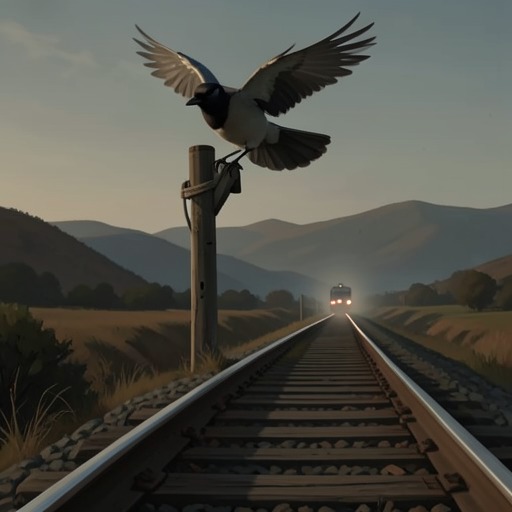
Magpies
The Girl on the TrainMagpies are a recurring motif whose chatter links an early morning walk, a tense encounter between Rachel and Tom, and Rachel’s later disoriented recollection. The counting rhyme turns their presence into an omen, while its repetition connects scenes across the novel.
Recurrence and Omen
During a pre-dawn walk in February, the speaker hears magpies overhead and recites the rhyme from one bird associated with sorrow through seven associated with a secret. The birds’ presence is described as watchful, and the speaker reflects that there are secrets to keep; Scott is away, leaving the speaker free to do as she wishes. The rhyme therefore appears alongside secrecy, but the passage does not explain what its secret is.
On August 18, magpies chatter above Rachel and Tom as they walk away from their car. The setting initially appears calm, yet Rachel is trying to find a way to speak to Tom after an earlier confrontation. The birds’ angry sound makes them a presence in the scene without establishing them as anything more than birds in the trees.
After Tom approaches Rachel and she falls, the counting rhyme returns in her fragmented perception. Its repeated stopping point, at three for a girl, links this moment to an earlier passage in which the same words accompany Rachel’s confusion. The rhyme does not clarify what has happened; instead, its recurrence gives the birds an ominous association and makes the scene’s uncertainty audible. Across these appearances, magpies shift from part of the natural setting to a repeated signal of sorrow, secrecy, and impending trouble.
The Rhyme's Changing Form
The motif’s force comes partly from a change in form: in the February passage, the counting rhyme runs through its sequence to the number seven, which is associated with a secret; in Rachel’s later recollection, it circles around the number three and cannot progress. That formal break turns counting from a seemingly complete pattern into a sign of interrupted thought. The birds remain part of the scene, but their sound becomes entangled with Rachel’s uncertain perception: she hears them as mocking, then distinguishes the birds from something else approaching. The rhyme therefore does not solve the mystery surrounding her recollection. It marks the point where an ordered, familiar verse gives way to uncertainty.
A Refrain Across the Narrative Frame
The same passage appears first under Rachel’s July 5 heading and returns under her August 18 entry, where the walk with Tom supplies the scene that the earlier fragment withholds. This recurrence makes the motif part of the novel’s arrangement as well as its imagery: a disorienting moment is presented before its circumstances become legible, then encountered again within a dated sequence of events. The birds’ refrain thus accompanies a shift in the reader’s understanding, from an isolated fragment to a scene whose stakes are clearer, without turning Rachel’s uncertain perception into a complete explanation.
Narrative Function
The magpies’ meaning arises from the contrast between their ordinary place in the trees and the significance Rachel gives their calls through the counting rhyme. In the February entry, the verse reaches its final number and its reference to a secret sits beside the speaker’s admission of secrets; later, the rhyme stalls at three as Rachel’s perception becomes fragmented. The birds do not explain the events or resolve what Rachel cannot yet understand. Instead, their recurring sound marks the distance between an ordered pattern and an experience that resists ordering, making the motif a thread through the novel’s shifting presentation of memory.